For thousands of years, people predicted the weather without smartphones. Ancient farmers, sailors, and explorers used their eyes and experience. These methods are just as effective today.
Learning to track weather without technology is a valuable skill. You might hike in places without cell service. Or, a power outage could happen in your area. Observing nature for weather patterns lets you feel more connected to the world.
This skill is easy to learn. You don’t need special training or expensive tools. Just your attention and a desire to learn from nature is enough.
In this article, you’ll learn to read cloud formations like a pro. You’ll also discover what animals do when the weather changes. Plants and insects send signals too. You’ll learn about atmospheric pressure and wind patterns without gadgets.
Tracking weather without technology connects you to ancient traditions. These methods are surprisingly accurate when you understand them. Start noticing the world around you, and predicting the weather will become second nature.
Table of Contents
Understanding Traditional Weather Forecasting Methods
Before smartphones, people used their eyes and knowledge passed down through generations to guess the weather. These methods have been around for thousands of years. They are useful today, when technology fails or you’re far from a signal. Learning how our ancestors forecasted weather connects us to skills that have helped us survive and thrive everywhere.
The History of Natural Weather Prediction
Ancient civilizations were experts at predicting the weather long before we had modern tools. The Babylonians made cloud atlases around 1200 BCE. They recorded sky patterns. Native American tribes tracked weather by watching animals and plants. European farmers used almanacs based on the moon and past weather to plan planting and harvest.
Sailors were great at reading the ocean and sky. They used waves, clouds, and colors to predict storms. These skills were passed down and saved lives. The saying “red sky at night, sailor’s delight” comes from these observations.
Why Traditional Methods Are Important Today
You might ask why we need to learn about predicting the weather today. The reason is simple: technology can fail. Power outages, dead batteries, and no signal are real issues. Knowing how to predict the weather keeps you safe when you’re hiking or camping in remote areas.
Traditional weather forecasting helps you understand why weather happens, not just what it says. This knowledge makes you more aware of your local climate. It also helps you spot dangerous conditions. Teaching kids about predicting the weather sparks their scientific curiosity through observation.
Learning these skills from navigation and observation resources shows that old methods are great with new ones. You become independent from technology and connect more with nature.
- Traditional methods work anywhere, anytime, without batteries or signals
- Understanding patterns builds scientific thinking and critical observation
- These skills have protected humans for thousands of years
- Local knowledge from natural weather prediction beats generic forecasts
- Emergency preparedness becomes easier with backup weather skills
Reading Clouds for Weather Prediction
Learning to understand clouds is key for predicting the weather. Clouds show us what’s coming, like a natural weather forecast. By watching the sky, you can guess rain, storms, or sunny days without your phone. It’s a simple skill that gets easier with practice.
Different clouds tell us about the weather. Spend time watching the sky to learn what’s above. Each cloud shape means something about the weather now and what’s coming.
| Cloud Type | Appearance | Weather Meaning |
|---|---|---|
| Cumulus | Fluffy, white, cotton-like with flat bases | Fair weather, stable conditions |
| Cirrus | High, wispy, feathery streaks | Weather changes within 24 hours |
| Stratus | Low, gray, layered sheets | Light drizzle or steady rain |
| Cumulonimbus | Towering, dark, anvil-shaped | Severe storms approaching |
Watch how clouds move and change. If clouds lower and thicken, rain is likely soon. If they break apart and rise, the weather might get better. Fast-moving clouds mean strong winds and possible weather changes. Slow-moving clouds suggest stable weather.
Pay attention to cloud colors at sunrise and sunset. Red skies at night mean fair weather. Red skies in the morning warn of storms. This is because of atmospheric dust and moisture.
- Check if clouds build vertically (instability and possible storms)
- Observe if clouds spread horizontally (more stable conditions)
- Notice cloud height and movement patterns daily
- Keep a simple journal tracking sky changes
- Practice reading clouds for weather regularly
Start a cloud journal to track patterns. Write down cloud types, their movement, and the weather that follows. Over time, you’ll get better at predicting the weather. Watching clouds regularly helps you connect with nature’s weather signs and builds your confidence.
Tracking Weather Without Technology Using Nature’s Signs
Nature is a great weather station if you know what to look for. Animals, plants, and insects react to weather changes before we do. By learning to spot these signs, you can predict storms and weather changes without needing a phone or app. This skill is as useful today as it was in the past.
The natural world sends us messages about weather changes. These messages come from changes in pressure, humidity, and even electromagnetic fields. Animals and plants can sense these changes naturally. Learning to track weather without technology helps you connect with your environment.
Animal Behavior as Weather Indicators
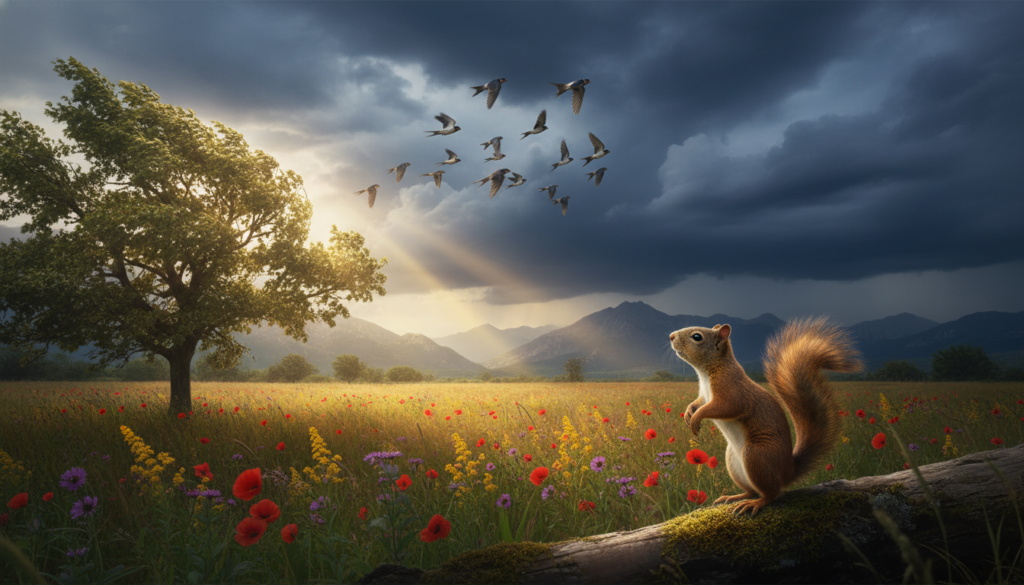
Animals can feel changes in the atmosphere through their bodies and instincts. Birds flying lower than usual often signal storms are coming. The drop in pressure affects their ears and the flight of insects, making birds hunt lower. Cows lying down in fields may also detect pressure drops before rain.
Watch for these animal behavior weather signs:
- Squirrels gathering food frantically before severe weather
- Frogs croaking louder when humidity increases before rain
- Spiders abandoning webs or building them in sheltered areas
- Pets becoming restless or seeking shelter during pressure changes
- Ants building up nest entrances before rainfall
Plant and Insect Responses to Atmospheric Changes
Plants and insects quickly adapt to changes in the atmosphere. Pinecones close tightly when rain is coming because of the humidity. In dry weather, they open up. Leaves showing their lighter sides indicate wind changes that often signal storms.
Flower petals close to protect pollen before rain. Bees return to their hives earlier when storms are coming. These signs help you track weather without technology.
| Indicator | Behavior | Meaning |
|---|---|---|
| Pinecones | Close tightly | Rain coming soon |
| Pinecones | Open wide | Dry weather ahead |
| Flower petals | Close completely | Precipitation likely |
| Tree leaves | Show light undersides | Storm winds approaching |
| Bees | Return to hives early | Bad weather coming |
Understanding these patterns makes you a nature detective. The signs you observe in animals and plants reveal weather secrets humans once overlooked. Start noticing these indicators in your yard and local area today.
Observing Atmospheric Pressure Indicators in Your Environment
Atmospheric pressure is the air’s weight on Earth’s surface. Spotting these indicators helps predict weather changes without special tools. When pressure drops, storms often come. When it rises, skies clear.
Reading Natural Signs of Pressure Changes
Watch how smoke acts around your home or campfire. Rising straight up means high pressure and stable weather. Flattening out or sinking signals dropping pressure and possible storms.
Sounds travel differently based on atmospheric pressure indicators too. Sounds carrying farther and clearer often show low pressure approaching. Distant mountains or buildings appearing unusually sharp suggest high pressure.
Pay attention to physical sensations. Many people feel joint pain, headaches, or ear pressure before weather shifts. Your body responds to atmospheric pressure indicators even when you cannot see them.
Building a Simple Pressure Tracker
You can make a basic homemade barometer with everyday items:
- Glass jar or container
- Rubber balloon
- Drinking straw
- Tape
- Marker
Cut the balloon and stretch it across the jar’s opening. Tape one end of the straw to the balloon’s center. Mark the straw’s position daily. Rising straw indicates climbing pressure. Falling straw shows dropping pressure. This low-tech tool reveals atmospheric pressure indicators in real time.
Understanding Pressure and Wind
Air flows from high to low pressure areas, creating wind. Rapid pressure drops bring stronger storms and fiercer winds. Gradual pressure changes mean gentler weather transitions. Track how wind direction and strength shift alongside atmospheric pressure indicators you observe. This connection explains the broader atmospheric picture around you.
| Atmospheric Pressure Indicator | What It Means | Weather Outlook |
|---|---|---|
| Smoke rising straight | High pressure present | Fair, stable weather |
| Smoke flattening or sinking | Pressure dropping | Storms approaching |
| Sounds traveling far | Low pressure developing | Possible rain coming |
| Distant views crystal clear | High pressure building | Clear skies likely |
| Joint or ear pain | Pressure changing | Weather shift soon |
Observing atmospheric pressure indicators turns your environment into a personal weather station. These natural signs cost nothing but attention. Practice spotting these clues daily. Soon you will predict weather changes like seasoned forecasters.
Folk Weather Prediction Techniques and Sky Observation
For generations, people have used folk weather prediction to guess the weather. These methods connect us to our ancestors who lived outdoors. They learned to read nature’s signs. Understanding these methods helps us see how our grandparents predicted the weather before science did.
These techniques mix sky watching with personal experience. By observing clouds and wind, you connect with the atmosphere. This ancient wisdom is valuable today, even with our modern technology.
Traditional Sayings and Their Scientific Basis
Weather sayings like “Red sky at night, sailor’s delight; red sky in morning, sailor’s warning” are surprisingly accurate. A red sunset means fair weather is coming. A red sunrise means rain might be on its way.
“Ring around the moon, rain soon” is true because cirrus clouds create halos before rain. These techniques show that halos appear 24 to 48 hours before rain.
“When dew is on the grass, rain will never come to pass” is true because dew forms on clear nights. These nights mean stable high pressure, which keeps rain away.
Here are some common weather sayings:
- Swallows flying low means rain will show
- Clear morning with frost suggests fair weather ahead
- Distant thunder signals approaching storms
- Smoke rising high indicates fair conditions
The swallow saying is true because insects fly lower in humid air. Swallows follow their food, so they fly lower when it’s wet.
Wind Patterns and What They Tell Us
Wind direction is like nature’s compass for predicting the weather. In the Northern Hemisphere, southerly winds bring warmer air and storms. North winds bring cooler, clearer air. By watching wind direction, you can forecast the weather.
Wind direction changes throughout the day. Clockwise wind shifts mean better weather, while counterclockwise shifts mean worse. Gusty winds often signal the arrival of fronts.
To find wind direction without tools, try these:
- Watch flags, branches, or grass movement
- Light a match or small flame to observe smoke direction
- Wet your finger and feel which side cools fastest
- Observe which direction clouds travel
- Notice where wind pushes leaves or dust
Wind speed is as important as direction. Steady winds mean stable weather, while gusty winds mean changes. Strong winds before storms are a sign of severe weather. Learning these patterns connects you to weather observers of the past.
Conclusion
You now have the tools to master natural weather prediction. You’ve learned to read cloud formations and watch animal behavior. These skills let you understand the weather around you. They work because they’re based on nature itself.
Start with just one method. Choose cloud observation or animal behavior. Learn it well and practice every day. Keep a weather journal to track your predictions.
Check your predictions against what actually happens. This builds your pattern recognition skills. Over time, you’ll get better at predicting the weather. Your connection to nature will grow stronger.
These traditional methods aren’t meant to replace modern technology. They work alongside it. They give you backup skills for when you can’t use a weather app. They make you more self-reliant and safer outdoors.
Every weather expert started where you are now. They watched the sky, listened to the wind, and observed plants and animals. You can do the same. The natural world is always teaching those who take time to look and learn.
Step outside today. Look up at the clouds. Feel the air. Watch the birds. Your education in natural weather prediction starts the moment you decide to pay attention.
FAQ
Can I really predict weather accurately without any technology or weather forecasting apps?
Yes, you can! People predicted the weather for thousands of years before smartphones. By learning to read clouds, observe animal behavior, and detect pressure changes, you can predict the weather. It’s all about paying attention to nature and practicing over time.
While technology is convenient, traditional methods are valuable when you don’t have cell service. They also help you connect with nature.
What are the most important cloud types I should learn to recognize for weather tracking?
You should learn about cumulus, cirrus, stratus, and cumulonimbus clouds. Cumulus clouds mean fair weather. Cirrus clouds signal weather changes in 24 hours.
Stratus clouds bring drizzle or light rain. Cumulonimbus clouds warn of severe weather. Watch how clouds move to predict the weather.
Clouds lowering and thickening mean rain is coming. Clouds breaking up and rising suggest better weather. Keeping a cloud journal helps you track patterns.
How do animal and plant behaviors help predict approaching weather?
Animals and plants are very sensitive to weather changes. Birds flying low before storms respond to pressure changes. Cows lying down and squirrels gathering food frantically also indicate changes.
Pinecones closing before rain and leaves showing undersides when wind shifts are signs too. These behaviors relate to pressure, humidity, and electromagnetic changes. Learning to recognize these signs makes you a nature detective.
What does atmospheric pressure have to do with weather prediction, and how can I detect it without a barometer?
Atmospheric pressure is the air’s weight on Earth’s surface. It’s key for predicting weather. Falling pressure means storms are coming, while rising pressure means it’s clearing.
You can detect pressure changes by watching smoke and how sounds travel. Distant objects’ clarity also indicates pressure changes. Many people feel physical sensations before weather shifts.
You can even make a simple homemade barometer to measure pressure changes without fancy equipment.
Is there scientific truth behind traditional weather sayings like “Red sky at night, sailor’s delight”?
Yes, many folk sayings have real meteorological basis. “Red sky at night, sailor’s delight; red sky in morning, sailor’s warning” is true because red sunsets indicate high pressure and dry air. Red sunrises suggest high pressure has passed and low pressure may be coming.
“Ring around the moon, rain soon” is accurate because cirrus clouds creating halos often precede frontal systems. “When dew is on the grass, rain will never come to pass” reflects that clear, calm nights indicate high pressure. “Swallows flying low means rain will show” because insects fly lower in humid, low-pressure conditions.
How do wind patterns and wind direction help me predict weather changes?
Wind patterns are excellent weather predictors. In the Northern Hemisphere, winds from the south often bring warmer, potentially stormy weather. North winds bring cooler, clearer conditions.
Changing wind direction signals weather transitions. Winds shifting clockwise often indicate improving weather, while counterclockwise shifts may mean deterioration. Wind speed and steadiness also provide clues.
You can determine wind direction without instruments by watching flags, observing smoke behavior, or simply wetting your finger to feel which side cools fastest. Understanding these wind patterns helps you recognize the broader atmospheric picture and anticipate weather shifts before they occur.
Why is learning traditional weather prediction valuable when I have weather apps on my phone?
Traditional weather prediction skills are invaluable in several practical scenarios. They provide critical backup information when technology fails. These methods help you develop a deeper understanding of local climate patterns and connect more meaningfully with nature.
Understanding the “why” behind weather patterns makes you a more informed observer. Traditional methods complement modern forecasting, increasing your self-reliance and outdoor safety awareness while connecting you to generations of weather observers.
How long does it take to become skilled at reading natural weather signs?
Becoming skilled at natural weather prediction requires patience and practice. Start simply by choosing one technique to focus on, like cloud observation, and gradually expand your weather awareness over time. The best approach is keeping a weather journal where you record your observations and predictions, then check how accurate you were.
This practice builds pattern recognition and deepens your understanding of local weather tendencies. Every expert weather observer started as a beginner, and the natural world is always teaching lessons. With consistent practice over weeks and months, you’ll develop genuine confidence in reading environmental signs that most people overlook, and your accuracy will improve substantially.
What should I do if my weather predictions based on nature signs contradict the official forecast?
Traditional observation methods and modern meteorological forecasts can both be accurate. They simply work on different timescales and information. Modern forecasts rely on satellite data, weather stations, and computer models covering large geographic areas, making them excellent for general regional predictions days in advance.
Your natural observations excel at detecting immediate, localized changes happening within hours. If your observations contradict the official forecast, consider that both might be right. Perhaps a localized weather pattern is developing differently than the broader forecast predicted, or your observations are catching early signs of changes that will unfold over the next few hours.
Use natural signs to fine-tune official forecasts for your specific location, treating them as complementary tools. This combined approach—official forecasts plus local observation—gives you the most complete weather picture for planning outdoor activities and staying safe.
Can I use these natural weather prediction methods to understand seasonal patterns and climate trends?
Yes, tracking weather without technology helps you understand both immediate weather changes and broader seasonal patterns. Ancient civilizations like the Babylonians developed sophisticated weather prediction systems based on careful observation, creating cloud atlases and seasonal indicators that guided agricultural and maritime activities.
Native Americans used seasonal indicators to understand climate patterns critical for survival. Farmers’ almanacs, developed through generations of observation, documented seasonal tendencies and climate variations. By keeping detailed weather journals throughout the year, noting cloud patterns, animal behaviors, atmospheric pressure signs, and wind trends, you’ll begin recognizing which weather patterns repeat seasonally in your specific location.
This deeper understanding of local climate tendencies makes you better prepared for seasonal changes and helps you recognize when conditions are unusual compared to historical patterns. Your observations contribute to the same tradition of natural weather literacy that has guided farmers, sailors, and outdoor enthusiasts for generations.
Are there any limitations to natural weather prediction that I should understand?
Traditional weather prediction methods excel at detecting immediate changes and short-term patterns, but they have limitations compared to modern technology. Natural observations work best for predicting weather within 24-48 hours and for detecting localized atmospheric changes. They’re less effective for predicting specific temperature readings, rainfall amounts, or severe weather arriving days in advance—information that requires satellite data and computer modeling.
Individual sensitivity to atmospheric changes varies significantly; some people clearly feel pressure changes while others notice nothing. Cloud reading requires clear visibility, which is impossible during fog or heavy precipitation. Weather patterns can be influenced by large-scale systems far beyond your observation area. Instead of viewing traditional methods as replacements for modern forecasting, think of them as complementary tools. Use official forecasts for medium-range planning while applying natural observation skills for real-time, local adjustments and for situations where technology isn’t available.
How can I teach children about weather prediction using natural observation methods?
Teaching children through direct observation makes science tangible and exciting. Start by simply spending time together watching the sky—point out different cloud types, discuss how they’re moving and changing, and make predictions together about what weather will arrive. Create a weather journal as a family project where children draw clouds, record animal behaviors, note wind direction, and make weather predictions they can check against what actually happens.
This builds observation skills while reinforcing the connection between cause and effect. Take nature walks to look for weather signs: animal behaviors, plant conditions, insects, and atmospheric changes. Discuss what each sign might mean and why animals and plants respond to atmospheric changes before humans notice them. Create a simple homemade barometer together to actually measure pressure changes with a glass jar, balloon, and straw.
Let children predict when storms approach based on their observations, then see if they’re correct. These hands-on activities develop critical thinking, pattern recognition, and scientific observation skills while making weather prediction feel like detective work.
What’s the best way to start developing my natural weather forecasting skills today?
Begin by choosing one single technique to focus on, like cloud observation, and gradually expand your weather awareness over time. The best approach is keeping a weather journal where you record your observations and predictions, then check how accurate you were.
This practice builds pattern recognition and deepens your understanding of local weather tendencies. Every expert weather observer started as a beginner, and the natural world is always teaching lessons. With consistent practice over weeks and months, you’ll develop genuine confidence in reading environmental signs that most people overlook, and your accuracy will improve substantially.