Moving to the countryside offers peace and quiet that many people crave. Rural living promises wide open spaces and close-knit communities. Yet, this peaceful setting comes with real security challenges that farm owners must understand and plan for.
Data from recent studies shows that rural crime rates sit at about half the level of urban areas. Rural regions experience 11.1 property victimizations per 1,000 people compared to 24.5 per 1,000 in cities. This sounds good, but more than 2 million home burglaries happen each year across the United States. Over one-third of assaults and 60% of rapes take place during home invasions.
Farms and ranches face unique risks that city homes do not encounter. Your property sits far from neighbors and emergency services. Valuable equipment, livestock, and crops attract thieves. Police response times can stretch from 30 minutes to an hour or more in remote areas.
The good news is that effective rural property security planning does not require extreme measures. Smart, strategic thinking works better than expensive fortress-like systems. Each property needs a custom approach based on its specific threats and valuable assets. Learn how agricultural property safety planning can protect your farm while keeping your rural lifestyle intact.
This guide walks you through practical security steps. You will discover how to assess real threats to your property. You will learn about physical barriers, lighting strategies, and electronic systems. Best of all, you can build a security plan that fits your budget and your way of life.
Table of Contents
Understanding Security Threats and Vulnerabilities on Rural Properties
Every farm and ranch has its own security challenges. To protect your property, first understand what you’re facing. Think of security as an equation: Threat plus Vulnerability equals Risk. A threat is someone who might steal or damage your assets. A vulnerability is a weakness in your defenses. Risk is what you might lose.
Start with a detailed farm security assessment. This lets you see your operation in a new light. You’ll find out what criminals might notice before you do. Your neighbors might seem friendly, but thieves often look for easy targets in rural areas. Even disgruntled former employees can pose a threat, knowing your routines.
Identifying Your Critical Assets and Prioritizing Protection
Think about what your farm can’t survive without. Your critical assets might include:
- Livestock and breeding animals
- Heavy equipment and tractors
- Fuel storage tanks
- Chemical supplies and fertilizers
- Grain storage facilities
- Water sources and irrigation systems
- Backup generators and power supplies
Rank these by importance. Losing your backup generator could mean losing livestock during a power outage. That makes generator security a top priority. The most valuable assets need the strongest protection.
Assessing Risk from the Adversary’s Perspective
Effective ranch protection starts with knowing your adversaries. Different threats have different motives:
| Threat Type | Motivation | Target Focus |
|---|---|---|
| Opportunistic Thieves | Quick profit from easy targets | Unsecured tools, fuel, small equipment |
| Organized Criminals | High-value theft operations | Catalytic converters, GPS systems, heavy machinery |
| Disgruntled Employees | Revenge or profit | Equipment, livestock, facility access |
| Vandals | Destruction for its own sake | Fences, buildings, vehicles, crops |
Walk your property like a criminal would. Look for poorly lit areas, broken fences, and unsecured gates. Notice which entry points are easiest to access. Check if expensive equipment is visible from public roads.
Talk with your local sheriff’s office about crime trends in your area. They know which farms have been targeted. This information is invaluable for developing effective ranch protection strategies. Understanding these threats helps you build defenses that address real risks.
Rural Property Security Planning: A Comprehensive Approach
To secure your farm or rural property, you need to understand three key defense layers. These layers are the base of both stopping rural crimes and protecting country estates. When used together, they form a strong security system that fights threats from all sides.
The first step in protecting your country estate is deterrence. This is your first defense. Visible security measures scare off criminals, making them think twice about attacking your property. It’s like making your place seem too hard to mess with.
Knowing the three-layer security model is key to creating a solid defense:
- Deterrence – Scare off criminals before they even try
- Detection – Warn you if someone tries to get in
- Delay – Slow down intruders so help can arrive faster
Not all criminals will be scared off by warning signs. That’s why stopping rural crimes needs more than one layer. Detection systems are your second line, alerting you to intruders with alarms, cameras, and sensors. Your detection plan should fit your property size and where your most valuable things are.
The third layer, delay, uses physical barriers to slow down intruders. Good locks, strong gates, and smart fencing give you time to call for help. Your delay tactics should be between your property lines and your most valuable stuff.
| Security Layer | Purpose | Example Methods |
|---|---|---|
| Deterrence | Keep criminals away from your property | Visible fencing, lighting, warning signs, security system badges |
| Detection | Let you know if someone is trying to get in | Motion sensors, alarm systems, cameras, personal awareness |
| Delay | Slow down intruders until help gets there | Reinforced doors, quality locks, strategic barriers, distance obstacles |
Your plan to protect your country estate should fit your unique situation. Think about how fast local police can respond, your property’s layout, and what’s most valuable to you. A good plan grows with you and changes as threats evolve.
Physical Protection Planning and Security Surveys
Understanding what needs protection and where weak spots exist is key to a strong farm security assessment. Many farm owners rely on insurance agents for property evaluations. These assessments mainly focus on fire and safety risks, not the full range of security threats.
Getting help from professionals who specialize in farm security gives a clearer view of vulnerabilities. Your local law enforcement offers free security surveys to spot weak points. Fire departments can also conduct risk surveys to identify fire hazards and suggest safety measures.
For farms planning to invest in security equipment, working with professional security consultants is worth the cost. These experts provide thorough evaluations and design custom protection systems based on your specific risk level.
Conducting Professional Security Assessments
When hiring a security consultant, ask for three key deliverables. Request a physical protection evaluation of your property layout. Ask for a site characterization that documents existing security features and gaps. Request a custom system design based on your unique risk profile and budget.
Your state’s Cooperative Extension Service educators can help you find qualified security professionals. They know which consultants understand farm-specific security issues. The USDA’s Animal and Plant Health Inspection Service website offers valuable information about diseases that could impact agriculture in your region.
- Property boundaries and fence conditions
- Gate security and locking mechanisms
- Building entry points and window security
- Lighting coverage around structures
- Vehicle and equipment storage areas
- Access roads and sight lines
Creating Asset Inventories and Emergency Response Plans
Document every valuable asset on your farm with detailed information. Start by listing items most likely to be targeted by intruders first. Include buildings, vehicles, machinery, computers, supplies, livestock, and crops. For each item, record serial numbers, photographs, and identifying marks.
Create a video record of your assets with clear dates and recognizable backgrounds visible in the footage. Store copies of your inventory off-site so you have records if your farm office is damaged. Update your inventory regularly as you add or remove equipment.
| Asset Category | Documentation Method | Storage Location | Update Frequency |
|---|---|---|---|
| Buildings and Structures | Photos with measurements and condition notes | Off-site safe storage | Annually or after changes |
| Machinery and Equipment | Serial numbers, photos, and identifying marks | Cloud storage and physical backup | When items added or removed |
| Vehicles | VIN numbers, registration, photos from multiple angles | Bank safe deposit box | After major repairs or purchases |
| Livestock and Crops | Inventory counts with video documentation | Secured digital files | Before and after seasons |
| Electronics and Technology | Model numbers, serial numbers, and setup details | Encrypted external drive | Quarterly |
Develop emergency response plans for various farm situations. Think about what happens if quarantine prevents you from selling grain or livestock. Calculate financial losses from crop or animal quarantine scenarios. Review your insurance coverage for losses related to quarantine situations.
Work with your local emergency responders through training exercises. Let them know your property layout and where your most valuable assets are located. Contact the EDEN website to find your state’s homeland security contacts. Review the FBI’s advisories on suspicious packages. Check your state’s hazard response plans for animal and plant emergencies.
Perimeter security for farms grows stronger when it starts with professional assessment and careful documentation. Taking these steps creates a solid foundation for all your security decisions going forward.
Implementing the Three Ls: Lock, Light, and Limit Access
The Three Ls are key to keeping farms and properties safe. They combine locks, lights, and access limits to defend your assets. This method is simple and doesn’t need expensive tech.
Each L builds on the last. Locks stop intruders, lights scare them off, and limits stop vehicles. This layered approach is very effective.
Lock: Your First Line of Defense
Locks work best when you manage your keys well. Use high-security locks that can’t be picked or tampered with. Make sure only authorized people have keys.
To control keys, follow these steps:
- Keep a record of all locks and where they are
- Track every key and who has it
- Make employees sign for keys
- Do key inventories often to check for missing keys
- Store spare keys and records safely
- Mark keys as “Do Not Duplicate”
Don’t hide keys in obvious spots. For important areas like fuel tanks, use keypad locks. This lets you change codes quickly if needed.
Make sure hasps lock over themselves. Use the same lock brand everywhere to spot unauthorized changes.
Light: Illuminating Your Vulnerabilities
Good lighting makes your property less inviting to trespassers. Motion-activated lights surprise intruders, making them leave.
Use these lighting tips:
- Put motion-sensor lights around key areas
- Use lights that turn on at dusk
- Direct lights to intruders, not your assets
- Keep buildings and fences clear of brush
- Leave a 15-foot clear zone around your property
Lighting up important areas shows you’re watching. Clearing brush makes it harder for trespassers to hide.
Limit Access: Creating Physical Barriers
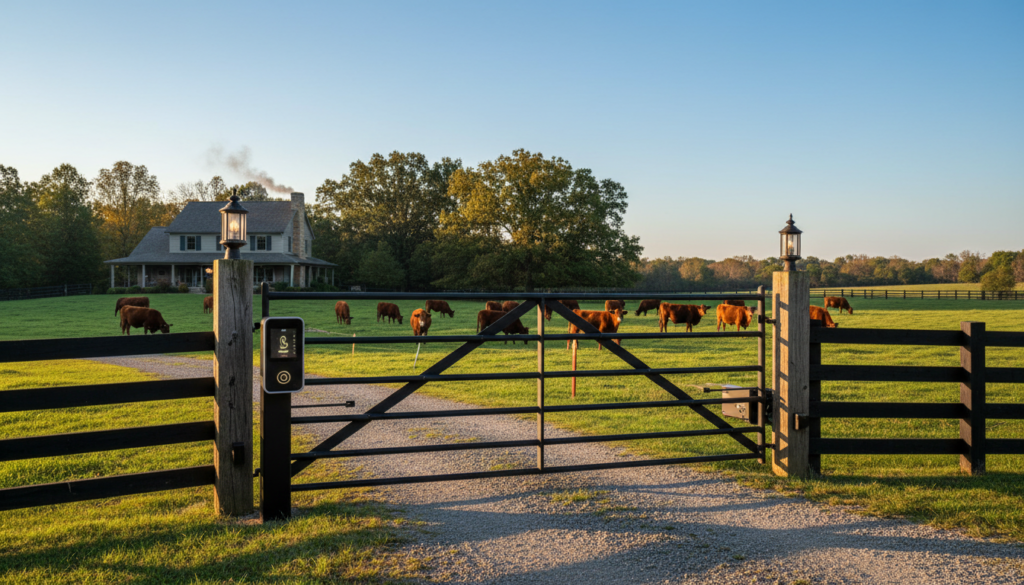
Limiting access means controlling who and what comes in. Lock gates to slow down unwanted visitors. Check gate hinges to prevent lifting.
More ways to limit access include:
- Install driveway enunciators to alert you to visitors
- Block ATV trails with large rocks
- Use strong chains and locks on gates
- Remove branches that could be used to climb fences
- Install cattle guards at entrances
| Protection Method | Cost Level | Effectiveness | Installation Time |
|---|---|---|---|
| High-Security Locks | Low to Medium | High | Quick |
| Motion-Activated Lights | Medium | High | Few Hours |
| Locked Gates | Medium | High | One Day |
| Vegetation Removal | Low to Medium | High | One Day |
| Rock Barriers | Low | Medium to High | Few Hours |
The Three Ls offer rural access control solutions that are easy on the wallet. Most farms already use locks. Adding lights and access limits boosts security. This foundation makes other security measures more effective.
This approach doesn’t require a big upfront cost. Start with better locks and lights. Then, add gates and clear the landscape. Improve your security step by step, based on your budget and property needs.
Electronic Security Systems for Farm Protection
Modern technology offers powerful tools to protect your rural property around the clock. Electronic security systems work best when installed after a professional security assessment. This ensures your technology investments address real vulnerabilities on your farm.
Remote property surveillance systems combine cameras, alarms, and sensors to create a complete monitoring network. These systems send real-time alerts to your smartphone, letting you watch your property from anywhere.
Electronic devices recommended for farm security include door and gate switches, motion sensors, video recorders, and access controls. Each component serves a specific purpose in protecting your assets and deterring trespassers.
Alarm Systems and Motion Sensors
Alarm systems protect entry points where intruders typically access properties. Door and window switches detect when someone opens these access points. Glass-break sensors add protection for vulnerable windows. Motion detectors placed strategically inside and outside trigger alerts when movement occurs.
Modern alarm systems feature keypads near main entrances for easy arming and disarming. Larger properties benefit from multiple keypads throughout the house. Most systems connect through cellular or internet links, sending notifications directly to your phone.
Motion-activated lighting proves more effective than timer-based lights because it creates surprise and uncertainty for intruders. Special motion-detecting bulbs fit standard light fixtures and cost very little. These bulbs stay dark until movement occurs, then illuminate for approximately one minute before returning to standby mode.
Alarm components work together to create a complete protection:
- Door and gate switches detect unauthorized entries
- Motion sensors activate lights and recording devices
- Glass-break sensors protect vulnerable windows
- Keypads allow armed and disarmed status control
- Cellular connectivity sends alerts to your phone
Video Surveillance and Trail Cameras for Property Monitoring
Video surveillance systems have become essential tools for farm security. Digital cameras paired with recorders and remote viewing allow you to monitor multiple locations from your phone or computer. Strategic camera placement protects entry points, valuable assets, and blind spots around your property.
Trail cameras serve multiple purposes on rural properties. These cameras monitor human activity near barns, equipment, and livestock areas. Most trail cameras use no-glow infrared technology for covert monitoring without alerting trespassers.
Consider these popular trail camera options for your property:
| Camera Model | Price | Key Features |
|---|---|---|
| Cuddeback Cuddelink | $180.00 ($10 monthly plan) | Connects up to 23 cameras, transmits up to 0.25 miles, daisy-chains up to 2 miles |
| Browning Strike Force HD Pro X | $154.99 | High-definition video, fast trigger speed, reliable performance |
| Bushnell Core DS No Glow | $199.99 | Invisible infrared, long battery life, clear night vision |
| Campark T90 | $99.99 | Budget-friendly, solid image quality, easy setup |
| Spypoint Force-20 | $99.99 | Cellular transmission, real-time image delivery, remote access |
| Moultrie Micro 42i | $87.99 | Compact design, dependable performance, value option |
| Reconyx Hyperfire 2 | $78.47 | Affordable, quality construction, proven reliability |
Strategic camera placement matters greatly for effectiveness. Position cameras to capture faces, not just silhouettes. Monitor entry points like gates and barn doors. Place cameras where valuable equipment stays. Cover blind spots around your property perimeter.
Remote property surveillance systems offer additional benefits beyond security:
- Doorbell cameras linked to your phone monitor visitors during your absence
- Trail cameras track predator activity around livestock areas
- Multi-camera systems cover large properties efficiently
- Motion-triggered video recording saves storage space
- Cellular-enabled cameras transmit images in real-time
Practical considerations for your video surveillance setup include weatherproofing for outdoor cameras, power options like solar panels or batteries, and storage solutions. SD cards provide local storage while cloud services offer backup access from anywhere. Always respect neighbor privacy while protecting your own property with thoughtful camera placement.
Protecting Information and Controlling Access to Your Farm
Keeping your farm safe is more than just locks and cameras. It’s also about protecting your farm’s secrets. Thieves often gather info before they strike. By limiting what info is shared, you can stop problems before they start.
Start with simple steps that cost nothing. Remove your name from the mailbox. This stops thieves from calling to see if you’re home. Full mailboxes and newspapers show your farm is empty.
When you travel, stop mail and newspaper deliveries. Ask a trusted neighbor to collect them instead. Place lights and televisions on timers to make your home look occupied at night.
Talk to local law enforcement to boost your farm’s safety. Tell them when you’ll be away for a long time. Ask them to include your farm in their patrols. Working with neighbors to watch each other’s properties can also help.
Managing Farm Information and Access Control
Don’t share what you grow or raise. Avoid talking about special crops or genetically altered animals. This keeps thieves and activists away.
Keep your computer safe to protect your farm’s records and money. Install and update anti-virus software often. Change passwords regularly. Use firewalls and shut down computers when not in use. Back up important files every night and store them somewhere safe.
- Control physical access to farm computers
- Update all security software monthly
- Change passwords every 60-90 days
- Disconnect continuously-connected computers at night
- Store backup drives in secure, off-site locations
- Avoid using business computers for casual Internet browsing
Personnel Security and Access Management
Do background checks on all employees, including seasonal workers. Make sure regular vendors check their drivers. Set clear rules for contractors’ access.
When an employee leaves, remove them from all lists right away. Take back their keys and access cards. Change passwords and alarm codes. Consider changing locks if you think keys were copied. Send a letter to the employee saying they can’t come back without permission.
| Access Control Task | When to Complete | Responsibility |
|---|---|---|
| Background checks on new hires | Before employment begins | Farm owner or manager |
| Vendor driver background checks | Before first delivery | Vendor company |
| Remove terminated employee access | On last day of employment | Farm owner or manager |
| Change security codes and passwords | Within 24 hours of termination | Farm owner or IT manager |
| Collect keys and access cards | Before employee leaves property | Direct supervisor |
These steps help keep your farm safe by protecting your data and controlling access. Strong security means keeping your farm’s secrets safe. Take time to set up these measures and adjust them for your farm.
Using Animals and Natural Deterrents for Property Defense
Living security systems are a reliable way to protect farms. Animals watch over properties without needing batteries or updates. Many strategies use technology with natural deterrents that have worked for centuries.
Guard animals and watchdogs are great at stopping both humans and wild animals. They act as the first line of defense.
Watchdogs, Guard Animals, and Livestock Guardians
Different animals play different roles on farms. Watchdogs alert owners with their bark when strangers come near. Guard dogs face threats head-on to protect the property. Livestock guardian dogs live with the animals they protect, forming strong bonds.
Watchdogs like German Shepherds, Rottweilers, and Doberman Pinschers are very alert. Their barking scares off many criminals. Livestock guardian dogs, such as Great Pyrenees, Anatolian Shepherds, and Maremmas, protect animals from coyotes and other predators.
Other animals also help prevent theft and control predators:
- Geese sound loud alarms when intruders approach and maintain territories aggressively
- Guinea fowl alert farm owners to strangers while eating ticks and insects
- Donkeys naturally dislike canine predators and protect sheep and calves effectively
- Free-range flocks of geese and guineas patrol property perimeters continuously
These animals need proper care, training, and integration into farm operations. They work best as part of a complete security plan.
Smart livestock management helps prevent theft. Keep detailed inventories with photos and marks. Secure animals in safe areas at night. Install cameras to monitor barns and pastures. Mark livestock with your farm ID and join identification programs.
Practices to control predators also help:
| Prevention Practice | Purpose | Benefit |
|---|---|---|
| Exclude meat, eggs, and dairy from compost | Prevents scavenger attraction | Reduces predator visits |
| Remove pet food from outside areas | Eliminates food sources | Discourages wild animals |
| Clean birthing areas promptly | Removes biological attractants | Prevents predator targeting |
| Secure poultry in predator-proof housing at night | Creates physical barriers | Eliminates easy prey |
| Remove or bury animal carcasses | Eliminates carrion sources | Reduces predator congregation |
The USDA says controlling predators is very profitable. For every dollar spent, farmers get $4.87 back. This brings economic benefits and peace of mind to property owners.
Animal-based security works best with other methods. Getting professional advice helps choose the right animals for your farm. Local agricultural services can guide you on managing guard animals effectively.
Conclusion
Perfect security is not possible on any rural property. Your goal is to create many layers of protection. This makes your farm harder to target than others nearby.
Rural Property Security Planning doesn’t have to be expensive. Many effective strategies start with simple steps that cost nothing. Train your family and employees to stay alert and aware of their surroundings.
Make security a part of everyone’s daily routine, not just one person’s job. Change your patrol patterns often and keep them unpredictable. This makes it hard for intruders to know when you’re checking your land.
Never risk someone’s life to protect buildings or equipment. If you see a serious threat or someone is in danger, call the police right away. They are trained to handle these situations better than you are.
Stay realistic about your security needs and budget. Start with basics like locks, good lighting, and controlled access points. Look at weak spots on your property and make improvements that fit your budget.
Rural crime can have bigger consequences because help is far away. Even small security upgrades can make a big difference. Review and update your security measures every year as your operation changes.
Your rural lifestyle offers peace and space away from crowds. Smart ranch protection strategies keep that peace while keeping your family safe. Build strong relationships with local law enforcement and neighbors.
These connections are more important in rural areas than anywhere else. You can defend your farm, family, and livelihood through informed planning and steady effort. Security is an ongoing process that fits into how you live and work.
FAQ
Why do I need a security plan if I live in a rural area with lower crime rates?
Rural areas have lower crime rates, but the consequences can be worse. Properties in rural areas are often far from help, making them more vulnerable. A security plan helps protect your property from threats.
What should be my first step in developing a farm security assessment?
Start by identifying what’s most important to your farm. Make a list of key assets that are essential. Then, talk to local law enforcement about crime trends in your area.
What are the three layers of effective rural property security?
Effective security has three parts: Deterrence, Detection, and Delay. Deterrence uses visible signs like lights and fences. Detection uses technology like cameras. Delay tactics slow down intruders until help arrives.
Should I hire a professional security consultant for my farm?
Yes, if you have valuable assets or want to invest in security. Consultants offer detailed evaluations and recommendations. They help ensure your security measures are effective.
What is the “Three Ls” approach to farm security?
The “Three Ls” are Lock, Light, and Limit Access. Locks control access, lights deter intruders, and limiting access controls entry points. These are basic but effective measures.
Why is key control so important for agricultural property safety?
Key control is key to farm safety. Keep detailed records of keys and locks. Use high-security locks and restricted key blanks to prevent unauthorized access.
What are the best remote property surveillance systems for large rural properties?
Choose systems after a professional assessment. Look for integrated systems with cameras and remote viewing. Consider power and storage options for your environment.
How effective are motion-activated lights for livestock theft prevention?
Motion-activated lights are very effective. They surprise intruders and deter them. Strategic lighting of assets and clear zones around fences enhance security.
What information security measures protect my farm from criminals gathering intelligence?
Operational security is key. Don’t show what you grow, and avoid suspicious purchases. Protect computers with anti-virus software and back up data regularly.
How do I protect critical documents and financial records on my farm?
Store important documents in fireproof cabinets. Keep digital backups off-site. This ensures your records are safe from theft or destruction.
What should I do when I identify vulnerabilities on my property?
Identify vulnerabilities and plan to address them. Use the Three Ls as a starting point. Prioritize based on risk and asset value.
How does community surveillance enhance rural property security?
Community surveillance is a powerful tool. Neighbors watching out for each other can deter crime. Build relationships and share information to enhance security.
What security measures integrate with my existing farm operations without disrupting daily activities?
Focus on operational security. Make security a shared responsibility. Use the Three Ls and add technology as needed.
How often should I update and review my farm security plan?
Review your security plan regularly. Changes in operations or threats require updates. Conduct assessments every 2-3 years or when significant changes occur.
What resources are available from government agencies for farm security planning?
Many government resources support farm security. The USDA, EDEN, FBI, and local law enforcement offer help. They provide information and assistance for security planning.
Should I contact law enforcement about security planning for my farm?
Yes, building relationships with law enforcement is important. They can offer free security surveys and advice. This ensures a quick response if needed.
What should I do if I detect suspicious activity on my farm?
Call law enforcement immediately if you see suspicious activity. Don’t confront intruders yourself. Document any incidents for insurance and future planning.
How does climate affect my rural property surveillance systems and security measures?
Climate affects the performance and longevity of security systems. Weatherproofing is essential. Choose equipment rated for your climate and maintain systems regularly.
Can I handle security improvements myself or should I hire professionals for installation?
You can handle basic improvements like locks and lights yourself. But, complex systems like surveillance and alarm systems require professional installation. Professionals ensure proper functionality and compliance with codes.
What’s the difference between security systems with professional monitoring versus self-monitoring?
Professional monitoring sends alerts to a service center, ensuring immediate response. Self-monitoring sends alerts to your phone, requiring your attention. Choose based on your needs and budget.
How do I handle security for seasonal agricultural operations and temporary workers?
Enhance security for seasonal workers by conducting background checks and training. Use temporary access cards and remove them when the season ends. Increase surveillance during peak seasons.
What liability issues should I consider when implementing extreme security measures?
Extreme security measures can pose risks to visitors and responders. Ensure warnings are clear and responders can access your property. Consult law enforcement and verify insurance coverage.
How can I improve security without spending significant money initially?
Start with the Three Ls and operational security. Use existing resources and budget-friendly options. Professional assessments help target your budget to the most important improvements.
What emergency response plans should accompany my farm security strategy?
Develop plans for various scenarios, including quarantine. Create contact lists and document procedures. Conduct drills to test your response and ensure everyone knows their role.
How does my farm’s location affect security planning priorities?
Remote properties need to delay intruders longer due to longer response times. Consider the location when planning security measures.