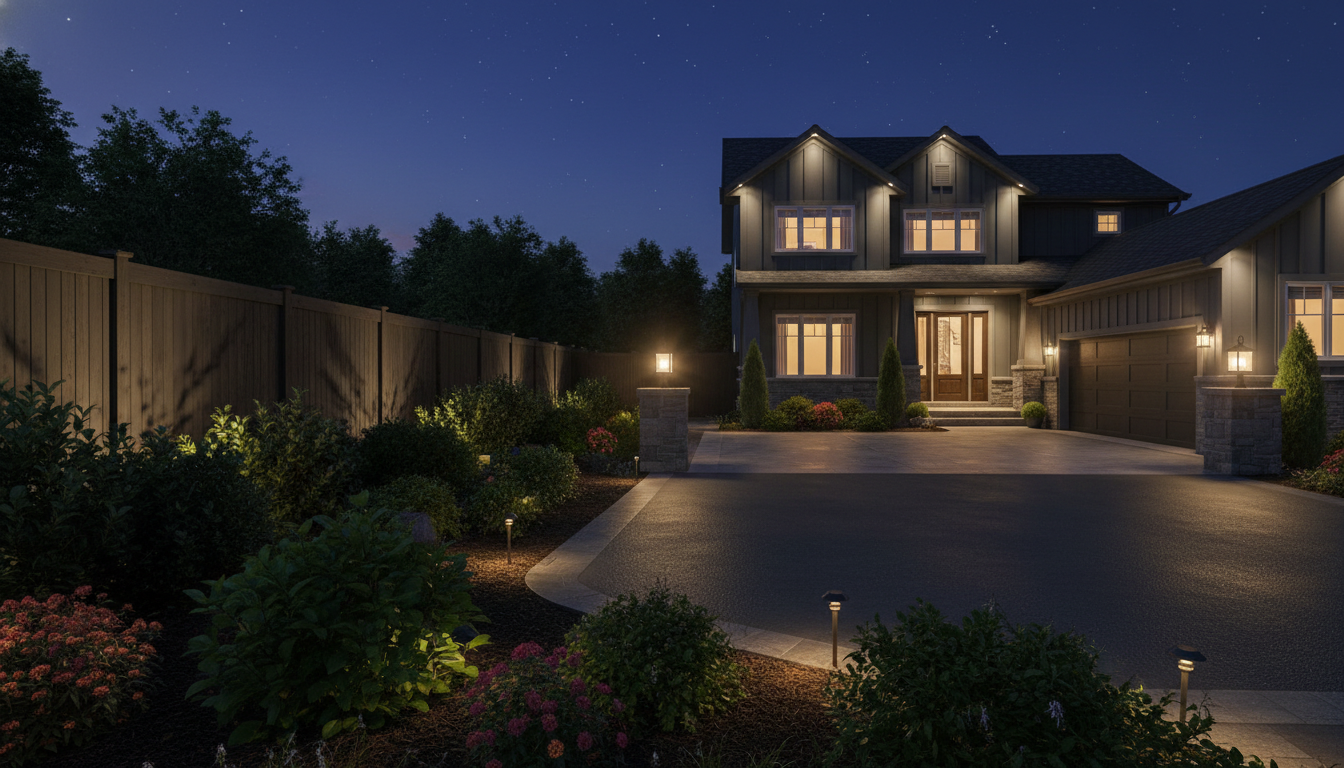
Your home’s perimeter is the first defense against unwanted visitors. Perimeter lighting for security creates a protective barrier. It keeps your property safe all the time. A good outdoor security lighting system makes dark spots bright, monitored zones that scare off burglars.
Most homeowners don’t know how powerful good lighting is. Criminals look for easy targets in dark neighborhoods. Bright, well-placed lights show your home is protected and watched.
Perimeter lighting is not just about being bright. It’s about smart planning for safety and energy savings. The right lighting keeps your family safe, prevents accidents, and makes your home welcoming.
This guide will teach you about outdoor security lighting systems. You’ll learn how to choose and place lights for your needs. We’ll cover energy-efficient options, smart controls, and maintenance tips for a strong system.
Investing in quality perimeter lighting is a smart move. It gives you peace of mind. Your home needs protection that works 24/7 to keep your loved ones safe.
Table of Contents
Why Perimeter Lighting is Essential for Property Protection
Your home’s safety needs many layers of defense. One key tool is property perimeter lights. These lights serve three main purposes. They scare off criminals, help security cameras work better, and keep your family safe.
Psychological Deterrence Against Intruders
Criminals don’t like the light. Studies show that bright homes are less tempting to burglars than dark ones. When your yard and entryways are well-lit, thieves think they might get caught.
Surveys of burglars show they avoid bright homes. They look for dark spots and overgrown areas. If a break-in takes too long, they move to easier targets. Your lights make them choose to leave.
- Criminals target entry points like front doors, back doors, and first-floor windows
- Dark properties appear more vulnerable and appealing to burglars
- Bright lighting increases the perceived risk of detection
- Most thieves avoid well-lit homes without hesitation
Enhanced Visibility for Surveillance Systems
Your security cameras need light to work. Without it, they record nothing useful. Property perimeter lights make sure your cameras capture clear images when needed.
Good lighting means your security system really works. It helps police and provides proof if needed. Without enough light, your cameras are just expensive decorations.
Reducing Accident Risks on Your Property
Safety isn’t just about crime. Dark yards can cause trips and falls. Without light, your yard is a danger zone after dark.
| Common Hazards in Dark Yards | How Lighting Helps |
|---|---|
| Tripping on uneven ground | Clear visibility of pathways and obstacles |
| Falling from steps or porches | Well-lit entryways and transitions |
| Stepping into holes or gaps | Complete ground-level illumination |
| Vehicle navigation difficulties | Bright driveways and parking areas |
Installing property perimeter lights keeps everyone safe at night. It’s a smart choice for a safer home.
Understanding Light Levels and Uniformity Standards
Getting the right brightness for your perimeter security starts with understanding footcandles. A footcandle measures how much light falls on a surface. It’s like a unit that shows if your yard is bright enough to keep intruders away and help surveillance cameras work well. Different areas around your property need different brightness levels, based on how secure they are.
Your front entrance and loading areas are high-risk zones that need stronger lighting than other areas. Experts say to keep entry points between 0.5 to 2.0 footcandles. Areas farther from your property line can have lower levels, around 0.2 to 0.5 footcandles. This saves energy and protects vulnerable spots.
Uniformity is as important as brightness levels. Dark spots can hide intruders. Security standards say to keep the ratio between the brightest and darkest areas below 4:1. This means if your brightest area is 4 footcandles, your darkest area should be at least 1 footcandle. This makes sure there are no hiding spots around your property.
Spacing your fixtures correctly prevents gaps in coverage. A basic rule is to not space them more than three to four times the height of the light. For example, if your fixture is 10 feet high, space them about 30 to 40 feet apart. Proper spacing and light levels make a strong deterrent system. For more on home security, check out best home security devices for preppers in emergencies.
| Security Zone Type | Light Level Range (Footcandles) | Location Examples | Purpose |
|---|---|---|---|
| High-Intensity Sterile Zone | 1.0–2.0 fc | Entry points, gates, loading docks | Deter intruders at access points |
| Medium-Intensity Perimeter Zone | 0.5–1.0 fc | Fence lines, building perimeters | General surveillance support |
| Lower-Intensity Attack Zone | 0.2–0.5 fc | Areas beyond property fence | Extend visibility without glare |
Understanding these standards helps you see if your current setup meets security needs. Divide your property into zones and measure brightness at different points. Uneven lighting can create safety problems and reduce camera effectiveness. By following these professional guidelines, you create a perimeter that protects your home like commercial security lighting solutions do for institutions.
Perimeter Lighting for Security: Choosing the Right Fixtures
Choosing the right fixtures for your property’s security is key. Modern lighting offers many options for different areas and challenges. Knowing your options helps you create a security plan that fits your budget and property.
LED perimeter security fixtures are top choices for homeowners. They use 75% less energy than old bulbs and last up to 50,000 hours. This means lower bills and fewer replacements.
LED Floodlights for Large Area Coverage
Exterior security flood lights are great for big areas like driveways and backyards. They mount on poles or walls and light up wide spaces. Many come with motion sensors to save energy and keep you safe.
- Mount on poles or building structures
- Cover large areas with single fixtures
- Often equipped with motion sensors
- Available in various brightness levels
Wall-Mounted Fixtures for Entry Points
Wall-mounted lights protect doors, garage entries, and windows. They’re good for small spaces and often have timers and brightness settings. They’re your property’s first defense against intruders.
Solar-Powered Options for Remote Locations
Solar-powered security lights are great for areas far from power. They charge during the day and light up at night without raising your bill. They’re perfect for fence lines and remote corners.
| Fixture Type | Best For | Key Features |
|---|---|---|
| LED Floodlights | Large open areas | High-intensity, motion sensors, pole or wall mounted |
| Wall-Mounted Lights | Entry points | Adjustable brightness, timers, compact design |
| Solar-Powered Lights | Remote locations | Energy-independent, eco-friendly, no wiring needed |
Low-voltage landscape lighting adds beauty and security. For harsh weather, marine-grade fixtures are best. Mixing different types creates a custom security lighting system for your home.
Strategic Placement for Maximum Coverage
Getting the right lighting in the right spots is key for your home’s security. Think of it like mapping your property to cover every dark corner. This method uses industrial lighting ideas but for homes. It means using fewer lights but getting better results.
Begin by walking around your property at dusk. Look for where shadows fall and where intruders might hide. Your front door, back entrance, side doors, and garage need bright light. These spots are where most break-ins occur.
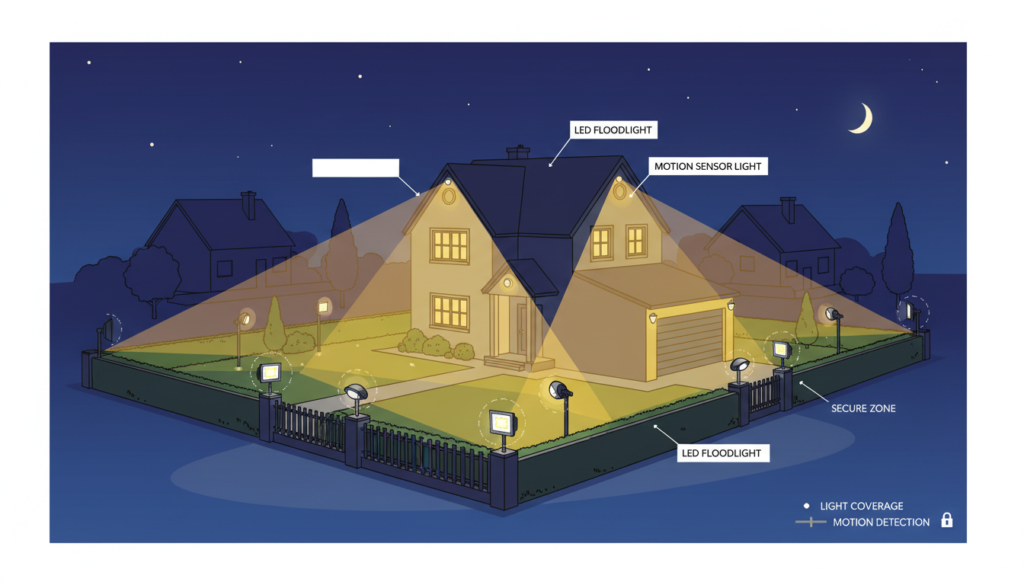
Then, think about pathways and walkways. Family members need safe routes at night. Driveways need light for vehicle safety and to prevent accidents. Garden pathways also help prevent trips and hide spots for intruders.
Key Areas That Need Light
- Front doors and main entrances
- Walkways and garden paths
- Driveway and parking areas
- Fence lines and property boundaries
- Corners and fence intersections
- Exterior amenities like decks or patios
- Side yards and dark corners
Mounting Height and Spacing
Mounting height is important for good coverage. Poles between 20-30 feet spread light far. But, higher poles make ground-level areas darker. Find a height that covers your space well without dark spots underneath.
Spacing between fixtures depends on beam angle. Wide beam fixtures need more space. Narrow beams require closer placement. Aim for at least 20 percent overlap between lights to avoid dark gaps.
Fence Line and Corner Considerations
Your fence line needs special care. Place fixtures to light both sides when possible. Inside mounting protects lights from vandalism. Outside mounting offers better coverage of approaching intruders. Corners and fence intersections create shadows. Place lights to eliminate these shadows.
Aiming angle is also key. Fixtures aimed at 60-75 degrees light your property well. Avoid pointing lights straight up to save energy. This angle prevents glare and maximizes ground coverage.
Strategic placement is about quality, not quantity. It saves money while improving protection across your property.
Smart Controls and Motion Sensor Technology
Modern security lighting has changed a lot. Today, motion sensor boundary lights and automated systems act like smart guards. They detect movement, adjust brightness, and send alerts to your phone. Plus, they save a lot on electricity bills and boost your home’s security.
Motion sensor boundary lights are like lights that sleep when no one’s around. They turn on bright when someone gets close. This startles intruders and alerts you to any activity.
Energy-Saving Automated Systems
Automated systems cut down on electricity costs a lot. They use 50 to 70 percent less energy than always-on lights. This leads to big savings on your utility bills every month.
These systems dim or turn off lights when there’s no activity. When someone moves, lights turn on fast. You can also control different areas separately. This means your backyard stays lit while side entrances dim when no one’s there.
Daylight Harvesting and Time-Based Controls
Daylight harvesting technology measures sunlight levels. It dims or turns off artificial lights during the day. As it gets dark, lights get brighter to keep visibility.
Time-based controls let you set schedules for different areas. Your front entry might stay bright until midnight, then dim. You can adjust these schedules as needed.
| Lighting Method | Operation Style | Energy Efficiency | Security Level | Best Use |
|---|---|---|---|---|
| All-Night Illumination | Constant full brightness | Low | High | Entry points and high-value areas |
| Motion-Activated Only | Dark until sensor triggers | Very High | Medium | Side yards and remote areas |
| Hi/Low Combination | Low light until motion detected | High | Very High | Combined perimeter coverage |
| Daylight Harvesting | Adjusts based on sunlight | Very High | High | All outdoor areas year-round |
Networked lighting systems take control to the next level. You can monitor and adjust settings from your smartphone anywhere. Real-time alerts notify you when motion sensors activate. Integration with other smart home devices creates seamless security automation throughout your property.
- Motion sensors provide early detection of approaching threats
- Automated systems reduce electricity costs significantly
- Daylight harvesting prevents daytime energy waste
- Time-based controls create flexible lighting schedules
- Remote smartphone access enables convenient monitoring
- Smart integration enhances overall home security
Installing motion sensor boundary lights and automated systems changes your security strategy. You get bright lighting and smart automation. Your property stays safe, and your electricity bills go down. Modern security lighting makes your home safer and smarter every night.
Minimizing Glare and Light Spillover
Outdoor security lighting systems work best when light reaches exactly where you need it. Glare and light spillover are two common problems. Glare happens when bright light shines directly into your eyes, making it hard to see. Light spillover occurs when your security lights spill onto neighboring properties or into the night sky.
These issues matter more than you might think. Excessive glare can blind security cameras and personnel, reducing the effectiveness of your entire system. Light trespass onto neighbors’ properties creates friction and may violate local dark sky regulations. Many communities have strict rules about light pollution, and breaking them can result in fines or citations.
The solution lies in selecting the right fixtures. Full cutoff fixtures direct light downward and, eliminating skyward light and unwanted spillover. These fixtures work like blinders on a horse—they focus light precisely where your property needs protection.
Smart installation practices make a real difference:
- Aim fixtures no more than 45 degrees from vertical to limit spillover into neighboring areas
- Use wing shields, barn doors, or louvers to block stray light beams
- Choose the lowest brightness level that provides adequate security
- Create a lighting plan that balances safety with efficiency
Finding the right balance matters. Too little light leaves your property vulnerable. Too much light wastes energy, bothers neighbors, and violates regulations. Quality outdoor security lighting systems achieve security goals without creating problems. Focus on precision and planning, not just brightness. This approach protects your home while keeping you on good terms with your community.
Maintenance Best Practices for Long-Term Effectiveness
Your property perimeter lights need regular care to stay strong. Without it, even the best systems can fail. Keeping them in good shape is easier than you think. Just a few hours of upkeep twice a year can save you money and keep your home safe all year.
Maintenance is a smart investment in your home’s security. Neglecting your lights can make them less effective over time. Dirt and debris can cut their brightness by up to 30 percent. Your lights work hard to keep your family safe, so they deserve your consistent care.
Regular Cleaning and Inspection Schedules
Begin with a simple maintenance plan. Clean your light lenses and reflectors every few months with a soft, damp cloth. Always turn off power before cleaning to stay safe.
Check your electrical connections every three to six months. Look out for these signs:
- Loose or corroded wires
- Visible damage to fixtures or connections
- Motion sensors that stop responding
- Dimmer controls acting strangely
- Backup power systems not functioning
Also, check if your lights are aligned properly. Weather and ground shifts can move them. A quick check ensures they’re pointing in the right direction.
Vegetation Management and Seasonal Adjustments
Plants grow faster than you think. That small shrub you planted three years ago might now block your lights. Regular trimming keeps plants away from your fixtures.
| Season | Maintenance Focus | Key Tasks |
|---|---|---|
| Spring | Growth Control | Trim overgrown plants, clear winter debris, test all systems |
| Summer | Dust Removal | Clean lenses frequently, remove pollen buildup, check for insect nests |
| Fall | Debris Clearance | Remove fallen leaves, clear gutters near lights, inspect for damage |
| Winter | Protection | Remove ice and snow carefully, check moisture seals, verify backup power |
Your lights need adjustments with the seasons. Winter ice and snow can change their angles. Summer storms might knock them out of place. Spring growth blocks light paths. Fall leaves create debris. Use this guide to stay ahead of problems.
Regular maintenance keeps your security system ready to protect your family every single night.
Conclusion
You now know the basics of perimeter lighting for security. A good system mixes effective lighting, energy savings, and follows local rules. Don’t worry, improving your home’s safety is manageable. Begin by checking your property’s weak spots, choose quality LED lights, and grow your system as you can.
Perimeter lighting does more than just prevent crime. It also lowers accident risks, boosts your home’s value, and might get you insurance discounts. Many insurers give discounts for homes with good security. A well-lit home means peace of mind, knowing your family and property are safe.
Today’s LED lights make things easier. They use less energy and last longer than old bulbs. Smart controls and motion sensors adjust to your needs, saving energy. Companies like Luminate Lighting Group help, from energy audits to full installations. They know about rebates that can save you money.
Your investment in perimeter lighting is about keeping your family safe. Every step counts, from adding a first motion-sensor light to a full system. Start your assessment today. A well-lit home is a safe home, and your family’s security is worth it.
FAQ
How much can perimeter lighting for security actually reduce my risk of break-ins?
Studies show well-lit properties are less attractive to burglars. Intruders avoid homes with good lighting because they’re more likely to get caught. With cameras and alarms, lighting can cut break-in attempts by up to 80%.
It’s not just about having lots of lights. Criminals look for dark spots to hide. So, making sure your property is well-lit is very effective.
What’s the difference between footcandles and lumens, and which one matters for my security lights?
Footcandles measure light on a surface, while lumens measure total light output. For outdoor lights, footcandles are what matter. They tell you how bright your property is.
Think of it like this: a light might have 5,000 lumens but shine it up into the sky. You won’t get any footcandles on your property. For security, aim for 2-5 footcandles for general areas and 10-20 for entry points.
Are LED perimeter security fixtures worth the extra upfront cost compared to traditional outdoor lights?
Yes, LED fixtures are worth it. They cost 20-30% more but save a lot of money in the long run. They use 75% less electricity and last much longer than traditional bulbs.
On a typical setup, you’ll save money within 2-3 years. Plus, they provide better light quality for surveillance. This makes them a smart choice for security.
What are footcandles and why do they matter for boundary illumination protection?
Footcandles measure light intensity at ground level. They tell you how bright your property is where it matters. For security, aim for 2-5 footcandles for general areas and 10-20 for entry points.
Understanding footcandles helps you avoid common mistakes. Don’t install overly bright lights that create glare. And make sure you have enough light in vulnerable areas.
How do motion sensor boundary lights actually improve security compared to constantly-on lights?
Motion-activated lights offer better security than always-on lights. When an intruder approaches, the sudden light startles them, often making them flee. They also detect movement, alerting you in real-time.
Plus, they use less energy because they only turn on when needed. For entry points and less-frequented areas, motion sensors are a great choice.
What exactly is light spillover and why should I care about it?
Light spillover happens when your lights shine on neighboring properties. It’s a problem because it wastes energy and can violate local regulations. It also makes your property less secure by creating glare.
Use full cutoff fixtures to direct light downward and across your property. This prevents light from going up into the sky or sideways to neighbors. Proper aiming angles and accessories ensure your lights protect only your property.
Can I install exterior security flood lights myself, or do I need a professional electrician?
It depends on the installation. If you’re adding lights to existing outlets or using solar options, you might be able to do it yourself. But for new circuits or tall structures, a licensed electrician is safer and often required.
For complex systems that integrate with smart home tech, professional installation is best. Start with what you’re comfortable with and bring in pros for the rest.
How should I position lights to eliminate dark corners and shadows where intruders hide?
Position lights to create overlapping zones of light. Make sure their coverage overlaps by at least 50%. This eliminates shadows where intruders can hide.
Pay attention to naturally dark areas like corners and under eaves. Mount fixtures at 8-12 feet to illuminate the ground without wasting light. Use a layered lighting approach for maximum coverage.
What’s the 4:1 uniformity ratio and why does it matter for my property perimeter lights?
The 4:1 ratio means the brightest spot should be no more than four times brighter than the dimmest. This ensures even lighting without harsh spots and shadows.
Good uniformity requires proper spacing and consistent fixture types. Aim for similar brightness levels across your perimeter to eliminate hiding spots.
Are solar-powered perimeter lighting options reliable enough for real security protection?
Modern solar options are reliable, but with some caveats. They work well in sunny areas but may not charge enough in cloudy or shaded spots.
Use solar for remote areas and traditional lights for entry points. Hybrid systems offer backup security for remote spots.
How often should I clean my outdoor security lighting fixtures and why does it matter?
Clean your fixtures at least twice a year. Dust and debris can reduce brightness by up to 30%, undermining your security.
Cleaning is simple: turn off power, use a soft cloth and mild soap to clean lenses and reflectors. Check connections and inspect for damage. This small effort ensures your lights provide full protection year-round.
What should I know about vegetation management around my security lights?
Plants grow faster than you think, creating hiding spots for intruders. Keep vegetation 3-5 feet away from lights and entry points.
Regular trimming is key. It keeps plants from blocking light and provides cover for intruders. Strategic landscaping and regular trimming enhance your security.
How does daylight harvesting work, and will it actually save me money on my electricity bill?
Daylight harvesting uses photocells to adjust light levels based on natural light. This can save 50-70% on energy costs. For example, it could cut your monthly bill by -25.
Over a year, that’s 0-420 in savings. Combined with motion sensors and LEDs, it’s a smart way to save energy and maintain security.
Can I control my security lights from my smartphone, and is it worth the extra cost?
Yes, you can control your lights with smartphone apps. It’s worth the investment for many homeowners. You can turn lights on/off, adjust brightness, and set schedules.
Imagine arriving home to lights already on or getting alerts when motion is detected. It’s convenient and adds real security value. Costs vary, but it’s a smart choice for energy savings and security.
What does full cutoff lighting mean, and how is it different from standard outdoor fixtures?
Full cutoff fixtures direct light downward and across your property. They don’t scatter light up into the sky or sideways. This makes them more efficient for security.
They concentrate light where you need it, saving energy and reducing glare. Many communities require full cutoff fixtures for their benefits. Upgrading shows you’re a responsible neighbor and improves security.
How do wall-mounted fixtures for entry points differ from floodlights, and which do I need?
Wall-mounted fixtures are for entry points like doors and windows. They provide focused light to block access. Floodlights cover larger areas, like driveways and backyards.
You’ll likely need both for complete coverage. Wall-mounted lights for entry points and floodlights for broader areas ensure your property is well-lit.
What’s the difference between time-based controls and motion-activated lighting?
Time-based controls turn lights on/off based on schedules. Motion-activated lights turn on when movement is detected. Time-based controls waste energy when no one’s around.
Motion-activated lights save energy and deter intruders. Use both for the best coverage. Time-based for entry points and motion-activated for perimeter areas.
How high should I mount my security lights, and does higher always mean better coverage?
Mount lights at 8-12 feet for good ground-level illumination. Higher lights waste energy by shining over intruders’ heads. Lower lights create glare and uneven shadows.
Consider the fixture type when choosing height. Test your setup at night for optimal visibility and minimal glare.
Do security lights actually increase property value, and will my insurance give me discounts?
Yes, security lights can increase property value by 1-3%. They also qualify for insurance discounts of 5-20%. Properly installed systems can quickly pay for themselves through savings.
Contact your insurance provider to see if you qualify. Investing in quality lighting can protect your home and increase its value.
What’s the best way to test my perimeter lighting system to ensure it’s actually effective?
The only accurate test is a nighttime visual inspection. Wait until it’s dark and walk your property perimeter. Note any dark spots or shadows where intruders could hide.
Check for light spillover into neighbors’ properties. Document actual conditions with photos. This nighttime assessment is more valuable than daytime checks. Test your system quarterly to catch issues before they compromise your security.
How do I know if my current lighting meets professional security standards?
Professional standards call for 2-5 footcandles for general areas and 10-20 for entry points. If you can walk your property at night without stumbling, you’re likely meeting standards.
Check for the 4:1 uniformity ratio and ensure entry points get enough light. If you find problems, adjust fixture angles or add lights. Professional consultants can help, but self-evaluation is a good starting point.