Most people tie their shoes every morning without a second thought. But what if you need to secure a rope to save someone’s life? That’s when lifesaving knot skills become your greatest asset. Knowing the right knot in an emergency can mean the difference between life and death.
Emergency knots for survival are not just for sailors or rock climbers. They are practical tools for everyone. Whether you’re in the wilderness, facing a natural disaster, or helping someone in distress, knowing how to tie reliable knots is key.
Consider Desmond Doss’s story during World War II. He used Bowlines to lower over 75 injured men down a cliff face to safety. His knowledge of one essential knot saved countless lives. This shows that mastering emergency knots is not just interesting—it’s life-changing.
Knot-tying is a skill many of us lack today. We may not have learned these techniques growing up. But, you don’t need to become an expert. Just learn five essential knots and practice them regularly.
A US Air Force S.E.R.E. (Survival, Evasion, Resistance, Escape) Specialist has been training others for over 30 years. This expert was “hooked after the first Bowline” during initial training. Soldiers learned about 25 different knots for various needs. You can start with the most important ones and build from there.
The most useful outdoor survival knots help secure gear, build shelters, and climb safely. They provide mechanical advantage, prevent slipping, and adjust under changing conditions. Each knot has a specific purpose in survival scenarios.
This article will teach you five lifesaving knot skills for real emergencies. You’ll learn why each knot is important and how to tie it correctly. By the end, you’ll feel confident handling rope in difficult situations. Your preparation starts now.
Table of Contents
Why Learning Emergency Knots for Survival Is Essential
Learning survival knot tying techniques can open doors to self-reliance you might not expect. A simple rope becomes powerful when tied correctly. This knowledge gives you confidence in unpredictable situations, whether you’re in the backcountry or dealing with unexpected emergencies at home.
Many experienced outdoors people say that critical knots for emergencies form the backbone of true preparedness. These skills work best alongside knowledge of shelter-building, water management, and food security. The combination creates a rounded survival toolkit that handles real challenges you might face.
Building Critical Self-Reliance Skills
Self-reliance doesn’t mean being paranoid about disasters. It means having real capabilities when situations go wrong. When you master wilderness survival knots, you reduce your dependence on equipment that might fail or disappear when you need it most.
A single piece of rope transforms into a versatile tool through proper knot work. You can secure loads, create anchor points, and build emergency structures. This transformation builds your confidence and resilience in ways that specialized gear cannot match.
- Increased confidence in outdoor activities
- Reduced reliance on specialized equipment
- Personal capability during emergencies
- Better problem-solving skills under pressure
Real-World Applications Beyond the Wilderness
These skills reach far beyond backcountry adventures. Critical knots for emergencies apply to everyday situations that catch people unprepared. Sailors, hunters, campers, and boaters depend on these abilities constantly.
Think about securing a canoe to your car before a camping trip. Picture hanging a tarp during a sudden downpour at your property. Consider tying off gear during a move or securing loads on a truck bed. Experienced sailors spent decades trusting that their rope work meant safety and security on the water.
| Real-World Scenario | Required Knot Application | Skill Benefit |
|---|---|---|
| Securing camping gear to a vehicle | Tight, reliable fastening | Prevents loss or damage during transport |
| Emergency home repairs | Quick and temporary fixes | Provides immediate solutions |
| Setting up emergency shelter | Adjusting tarp and tent lines | Protects you in bad weather |
| Recreational boating and fishing | Secure dock lines and gear | Ensures water safety |
| Pulling a bear hang for food safety | Hoisting systems using mechanical advantage | Keeps wildlife away and protects supplies |
| Urban emergency situations | Creating rescue anchor points | Enables emergency assistance |
Generational knowledge of rope work has real, practical value for modern life. Parents teach children, experienced outdoors people mentor newcomers, and communities pass down these essential abilities. Your investment in learning survival knot tying techniques today pays dividends tomorrow, whether you’re planning a weekend camping trip or preparing for the unexpected.
Understanding Knot Fundamentals and Terminology
Learning survival rope work basics might seem tough at first. But, these sailor-sounding terms are easy once you get them. Knowing the essential emergency rope knots is key to tying them right and safely.
First, learn the parts of your rope. The working end is what you use to tie the knot. The standing end is the fixed end. The body is the middle. Think of these as your rope’s parts.

Then, learn the rope’s shapes. A bight is a kink in the rope. An overhand loop happens when the working end crosses over. An underhand loop is when it crosses underneath. A turn wraps 360 degrees, and a wrap goes around objects.
It’s important to know the difference between knots, hitches, and bends. A knot uses just the rope. A hitch needs something else to work. A bend joins two rope ends. Knowing this helps you choose the right technique.
Don’t forget about dressing your knot. This means making it neat and tidy. A well-dressed knot doesn’t slip and works well when needed. The tail or tag end is the short part left after tying.
Learning these terms makes you understand essential emergency rope knots. Check out resources on essential wilderness survival skills. With this knowledge, you’re ready to learn five lifesaving knots.
Five Lifesaving Knots Every Survivalist Should Master
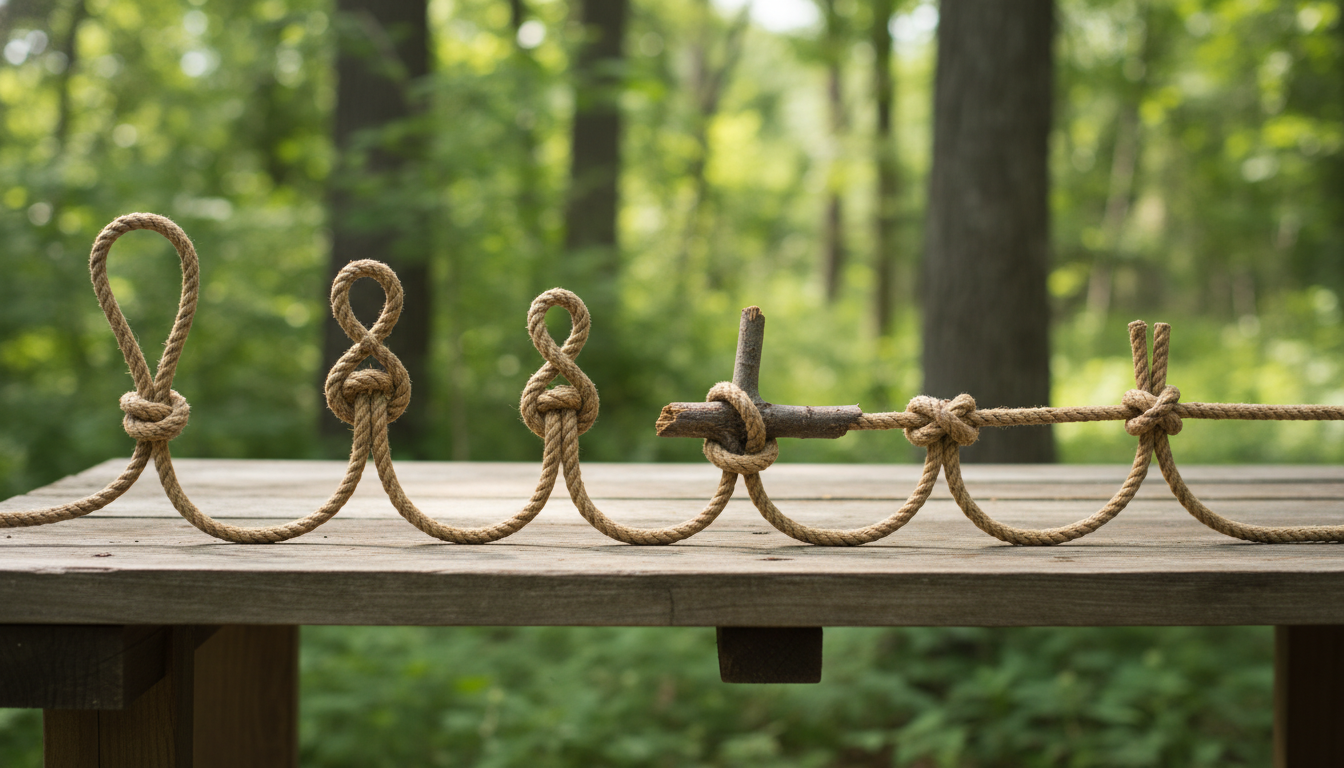
Knowing how to tie outdoor survival knots is key to handling emergencies well. These five knots are essential for any survivalist. Each one has a specific use and can be a lifesaver in critical situations. Learning these knots prepares you for wilderness adventures and unexpected emergencies.
The Bowline: King of Fixed Loops
The Bowline is the most reliable knot for survival. It makes a fixed loop that won’t slip, even when it’s under a lot of pressure. This is very important in survival situations. You can tie it with one hand and it’s easy to release when needed.
To remember how to tie a Bowline, think of a rabbit going through a hole, around a tree, and back through the hole. It’s great for rescues, making handles, and securing gear. It’s also useful for creating anchors and lowering yourself safely.
For an emergency knot tying guide, always tie the tail inside the loop to avoid snags. To untie it after heavy use, just lift the loop to release the tension.
Double Sheet Bend: Joining Ropes of Different Sizes
The Double Sheet Bend is perfect for joining ropes of different sizes. It ties quickly and comes apart easily, making it great for survival situations. You need speed and reliability in the field.
- Start with the thicker rope and create a bight
- Thread the thinner rope through the bight
- Wrap the thinner rope back around both parts of the bight
- Dress the knot carefully to ensure proper alignment
Use this knot to extend lines, create clotheslines, or hang food safely. It’s also good for joining short lines for shelter. The double version is even more secure on slippery materials.
Halter Hitch: Quick Release Under Tension
The Halter Hitch, also known as a Slipped Half Hitch, is great for quick releases even under heavy strain. It’s perfect for securing gear, tying stake lines, or attaching food bags to bear hang systems.
The strength of this hitch comes from friction with the object it wraps around. To untie, just pull the tail sharply and it releases right away. This makes it essential for survival situations where quick adjustments are needed.
Trucker’s Hitch: Creating Mechanical Advantage
The Trucker’s Hitch, also known as a Wagoner’s Hitch, is great for tightening lines. It’s perfect for securing shelter lines in windy conditions or heavy loads. It multiplies your pulling strength, making it very useful.
This knot works by creating a movable loop that acts like a pulley system. It allows you to pull with less effort while achieving maximum tension. It’s a go-to for campers and preppers in emergency situations.
Clove Hitch: Versatile Anchoring Solution
The Clove Hitch is one of the most versatile knots for outdoor survival. It cinches securely around trees, posts, and vegetation. It’s ideal for stake placement and line tying.
| Knot Type | Best Use | Release Difficulty | Speed to Tie |
|---|---|---|---|
| Bowline | Fixed loops for rescue | Easy | Fast |
| Double Sheet Bend | Joining different rope sizes | Easy | Fast |
| Halter Hitch | Quick release under load | Very easy | Very fast |
| Trucker’s Hitch | Creating rope tension | Moderate | Moderate |
| Clove Hitch | Anchoring to objects | Moderate | Very fast |
Learning these five knots through an emergency knot tying guide is a solid start for emergency preparedness. Practice each knot until you can tie them without thinking. When emergencies happen, your muscle memory will keep you safe.
Practicing and Perfecting Your Knot-Tying Skills
Learning survival knots takes time and effort. Without regular practice, even the most important skills can fade. You don’t want to struggle with tying essential emergency rope knots when your safety depends on speed and accuracy. The key to real mastery is simple: practice until these knots become muscle memory.
Building competence with survival knot tying techniques requires the right materials and consistent effort. Start with short training sessions and gradually increase your difficulty. Keep your practice cordage accessible in your backpack, camping kit, or emergency bag. This way, you can practice during downtime outdoors or at home.
Choosing the Right Cordage for Training
Seven-strand 550 paracord is the best choice for learning essential emergency rope knots. It’s lightweight, packable, and works well for most outdoor tasks. Brands like 5col offer quality options that reviewers trust.
When practicing with standard 550 cord, use a 6 to 8 inch tail for proper technique development. Pay close attention to your cordage’s strength rating, as it’s important for real situations. Different rope types have unique characteristics that affect performance.
| Cordage Type | Best For | Strength Rating | Water Absorption |
|---|---|---|---|
| 7-Strand 550 Paracord | General training and outdoor use | 550 pounds | Low |
| Double Braid Nylon Rope | Secure anchoring and load-bearing | Variable (typically 600+ pounds) | Moderate |
| Natural Fiber Rope | Traditional applications | Lower than synthetic | High |
Common Mistakes to Avoid When Tying Emergency Knots
Many people tie knots sloppily without realizing the danger. A poorly dressed knot looks messy and functions badly. When lines twist or don’t lay flat, they create weak spots that slip under pressure.
The difference between a safe knot and a dangerous one comes down to precision. No partially correct knots exist—they work completely or fail completely. Small variations in how you tie essential emergency rope knots can completely undermine their security.
Focus on these critical points when practicing survival knot tying techniques:
- Keep all lines straight and parallel without twists
- Dress your knots neatly before applying load
- Tighten knots firmly so they stay locked in place
- Double-check your work before relying on the knot
- Practice the same knots repeatedly until your hands remember the motions
Different rope types require different approaches. While the five essential emergency rope knots work well with paracord and double braid nylon rope, specialized activities like fishing or climbing need their own specialized knots. Learn what works best for your specific needs and environment.
Conclusion
You now know the basics of emergency knots for survival. The five knots we talked about—the Bowline, Double Sheet Bend, Halter Hitch, Trucker’s Hitch, and Clove Hitch—are essential. They help you in many survival situations, like building a shelter or securing your gear.
These knots are reliable, unlike modern gear that can fail. A well-tied knot works every time. Next time you see someone struggling with straps, you can use these knots to secure your load. A simple shake of the rope will show you that your cargo is safe.
Don’t wait for an emergency to start practicing. Keep some cord handy and learn one knot each week. At first, these knots might seem hard, but with practice, they become easy. Soon, you’ll tie them without even thinking.
This knowledge connects you to sailors, climbers, and survival experts. You’re not just learning knots. You’re gaining real skills and confidence. This confidence is worth the effort to learn emergency knots.
FAQ
Why are emergency knots considered lifesaving skills that go beyond just camping trips?
Emergency knots are key survival skills that boost your confidence in tough times. They’ve saved lives, like at Hacksaw Ridge. Knowing these knots can mean life or death.
These skills are not just for the wilderness. They’re vital for everyday emergencies and when modern tools fail. A simple rope can be a lifesaver with the right skills.
Can someone with no knot-tying experience realistically learn these survival knot techniques?
Yes, anyone can learn these essential knots. They’re not just for experts. With practice, you’ll master them in no time.
Start with the basics and practice regularly. Soon, tying knots will become second nature.
What’s the difference between essential survival rope work basics and specialized knots used in technical activities?
The five essential knots work well with common ropes found at outdoor stores. They’re perfect for general survival needs.
But, specialized activities need different knots. These basics give you a solid foundation for more advanced skills.
What does “dressing a knot” mean, and why is it important for knot security?
Dressing a knot means arranging the rope neatly. It ensures the knot works as intended. A sloppy knot can fail.
David Seidman says there are no half-right knots. Proper dressing is essential for a knot’s reliability.
What makes the Bowline the “king of knots” for emergency situations?
The Bowline is the “king” because it creates a secure loop. It’s easy to untie, even under heavy loads. It’s fast to tie and works with most ropes.
It’s used for rescues, creating handles, and more. Its versatility makes it a go-to for emergencies.
How do I know if I’m tying a Bowline correctly, and what’s the classic way to remember the technique?
Use the “rabbit, tree, hole” mnemonic to remember the Bowline. The rabbit goes up, around, and down the hole.
Check that the Bowline’s tail is inside the loop. This ensures it’s safe and secure.
What are the key survival knot tying techniques I should focus on first?
Start with the Bowline, Double Sheet Bend, Halter Hitch, Trucker’s Hitch, and Clove Hitch. These are the basics for emergency situations.
Each knot has a specific use. Practice one at a time to build a solid foundation.
Why should I learn critical knots for emergencies when modern equipment like ratchet straps and carabiners is available?
Modern gear has its limits in emergencies. It can fail or be lost when you need it most. Rope and knots are always reliable.
Knowing essential knots makes you self-reliant. It gives you peace of mind and confidence in emergencies.
How do different rope types affect which emergency knots work best?
Rope type, thickness, and properties affect knot performance. Paracord and double braid nylon are good for beginners.
Test your knots with the rope you’ll use in emergencies. Different ropes may need different techniques.
What’s the difference between knots, hitches, and bends, and why does this distinction matter?
Knowing the difference helps you choose the right technique. A knot creates a loop, a hitch attaches to an object, and a bend joins ropes.
Using the wrong type can fail. Understanding these distinctions ensures you adapt to any situation.
What are the most common mistakes people make when learning emergency knots?
Many assume a rope loop is secure without proper dressing. Rushing through practice or tying in low light is common.
Practice consistently to build muscle memory. This ensures you can tie knots reliably in emergencies.
How should I choose the right cordage for practicing survival knot tying techniques?
Choose cord that mirrors emergency situations. Double braid nylon and paracord are good for beginners.
Practice with 50 to 100 feet of rope, 3/8 inch to 1/2 inch in diameter. Avoid thin string for proper technique.
Why is it important to learn these essential emergency rope knots before an actual crisis occurs?
Learning in calm conditions builds muscle memory and confidence. This is why military and outdoor experts train before emergencies.
Preparation today means capability tomorrow. It also builds self-reliance and reduces anxiety about emergencies.
Can learning these five essential knots really prepare me for most emergency situations?
Yes, these knots cover about 90% of emergency situations. They’re for creating loops, joining ropes, and securing loads.
Mastering these knots makes you prepared for various emergencies. They’re not just for sailing or climbing.
How do I develop the muscle memory needed to tie these knots reliably under stress?
Develop muscle memory through consistent practice. Learn one knot per week and practice daily until it’s automatic.
Practice in different conditions to simulate emergencies. This ensures you can tie knots even when stressed.
What is the Double Sheet Bend, and when should I use it instead of other rope-joining knots?
The Double Sheet Bend joins different-sized ropes together. It’s reliable under heavy loads and works with mismatched ropes.
It’s essential for emergencies where you might not have matching ropes. This versatility makes it a key skill.
What makes the Halter Hitch valuable for emergency situations, and what does “quick release” actually mean?
The Halter Hitch is quick and easy to release, even after heavy loads. It’s perfect for emergencies where fast action is needed.
It’s great for securing loads and creating handles. Its quick release feature is a lifesaver in tight spots.